You know the pattern from a beach you've walked for years. One week the sea pulls back past the last of the rocks, leaving a wide apron of wet sand and a scatter of pools that weren't there a fortnight ago. Ten days later, high water sits halfway up the same beach and low water never gets anywhere near your favourite gully.
Nothing has changed except the arrangement of the moon and the sun. Spring tides and neap tides are the two ends of a cycle that runs on roughly a fortnight, and once you can read it, a tide table stops being a list of numbers and starts being a plan for the day.
What actually moves the sea
The tide is mostly the moon's work. Its gravity pulls hardest on the ocean directly beneath it, and the planet answers with two bulges of water — one under the moon, one on the far side. As the Earth turns, every coastline passes through both, which is why most British beaches get two high waters and two low waters a day, about twelve and a half hours apart.
The sun tugs at the sea as well, but it is far enough away that its tide-raising effect is a little under half the moon's. That is the whole trick. The sun is the junior partner, and everything depends on whether it is pulling in the same direction as the moon or across it.
Spring tides: when the pulls line up
Twice a month, at new moon and again at full moon, the sun, the Earth and the moon sit roughly in a line. Their pulls combine, the ocean's bulges swell, and the difference between high and low water — the range — stretches out. That is a spring tide, and the name has nothing to do with the season. It comes from the older sense of the water springing up.
The biggest ranges usually arrive a day or two after the new or full moon. An ocean the size of the Atlantic doesn't change shape on command, and the tide carries a little momentum with it as it goes.
What a spring tide looks like on the shore
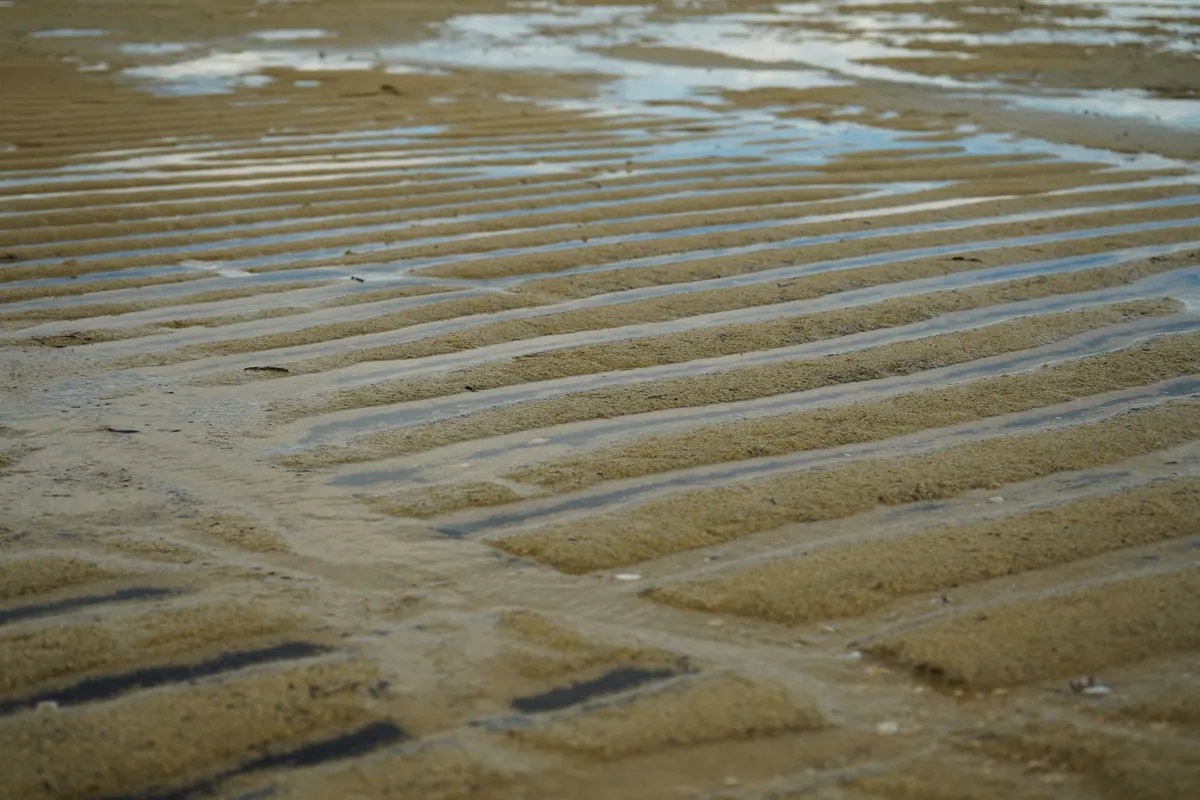
At a spring low, ground appears that you may never have seen: the lower edge of the beach, kelp-covered ledges, channels that only drain on the biggest tides, sandbars that show for an hour and then vanish. At a spring high, the same coast looks greedy. Slipways, causeways, harbour car parks and beach huts that are dry for most of the fortnight can be under water, so it is worth checking before you leave a car on a quayside.
Neap tides: the quiet middle
When the moon is at first or last quarter, it stands at right angles to the sun as we see it from Earth. Now the two pulls compete rather than combine, the bulges flatten and the range shrinks. These are neap tides, and they generally arrive about a week after the springs, giving you two neap periods a month.
The sea still rises and falls twice a day at a neap. It simply does less of it.
At a neap low, ground that was high and dry at the last spring low is still covered. Pools you scrambled down to last week may not exist at all, and a shallow channel you waded across on Tuesday can be ankle-deep by Friday. Rock poolers tend to write off neap lows; anyone who launches a boat over a sandbar will tell you the same.
The other things that change the range
Spring and neap are the main rhythm, but they aren't the only factors at work. Three others are worth knowing about.
The moon's distance
The moon's orbit isn't a neat circle. When it is closest to Earth, its pull is stronger and the tides run bigger than an ordinary spring. When it is furthest away, even a spring tide can feel a bit half-hearted. This is why some springs of the year are noticeably larger than others.
The shape of the coast
Identical tides produce very different beaches. Funnel-shaped estuaries amplify the range enormously — the Bristol Channel and the Severn Estuary see some of the largest tides in the world — while a sheltered bay or a wide, shallow beach may barely notice the difference. Local geography often matters more than the calendar.
Weather
Wind and air pressure shift water levels on top of the astronomical tide. A deep low-pressure system combined with a strong onshore wind can lift a spring high into places it has no business being, while settled high pressure and an offshore breeze can hold the water back and give you a lower low than the table promised. Forecast plus tide table beats the tide table alone.
Rock pooling on a spring low
If you want the best of the shore, plan around the lowest water of the fortnight. A few habits make the difference:
- Time your visit for the hour either side of low water. The pools are at their clearest and the tide is barely moving.
- Go on the day of the spring, or the day after. The lowest water often arrives slightly later than the table time rather than exactly on it.
- Work from the low-water mark upwards. Start at the furthest-out pools and retreat as the flood begins, rather than starting high up the beach and running out of time.
- Wear footwear with grip. Weed-covered rock is slippery whether it looks wet or not.
- Put every stone back as you found it and keep animals in water. Most rock pool creatures are tougher than they look, but not tough enough to survive a dry afternoon in a bucket.
Walkable sand, and the cut-off risk
Spring lows are the days for long walks across sand. Flats that are a thin strip at neap tide become wide enough for a proper leg-stretch, and features you'd only ever seen from a cliff path — old posts, wrecks, dark peat beds — come into view. On the right beach, that is a genuine pleasure.
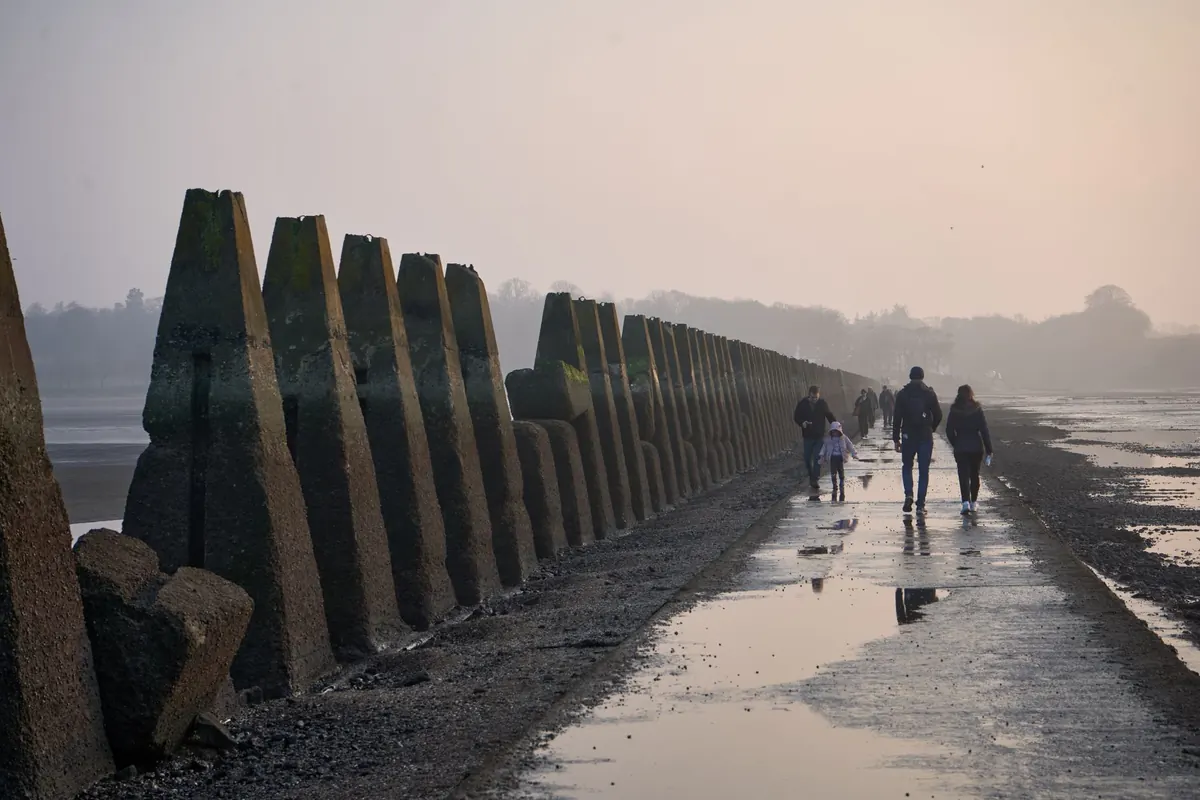
The catch is the return. A rising spring tide covers ground quickly, and on a flat beach it can come in behind you while you're looking the other way. A rough rule for a rising tide is that in the first hour it gains one twelfth of its range, then two twelfths, then three, three, two and one across roughly six hours. The middle hours are the fast ones. Estuaries and headlands are the worst places to be caught, because the water can fill the route you used to arrive before it ever reaches you.
Practical habits: pick a route with more than one way off the beach, use a fixed landmark to judge how fast the water is moving, and give yourself more time than you think you need. If a causeway, ford or tidal crossing is involved, check local harbour or coastguard information rather than relying on an app or on what you remember from last summer.
Planning your fortnight
Once you know the pattern, you can choose your days rather than take whatever the coast hands you:
- Find the next new moon and full moon. Springs fall within a day or two of each.
- Mark the two or three days after each as your big-tide days — best for rock pooling and for exploring sand that is usually submerged.
- Expect neaps about a week later. Use those days for sheltered coves, shallow estuaries, or a walk on a beach where you would rather not think about the water at all.
- Check wind and pressure before you go. A strong onshore blow on a spring tide is a day to watch from the clifftop, not the sand.
Tides are one of the few natural rhythms you can still build a week around: predictable, free, and different every fortnight. Learn which phase you're in, and the same stretch of coast will keep showing you something new.
Photo: Mi Le / Pexels